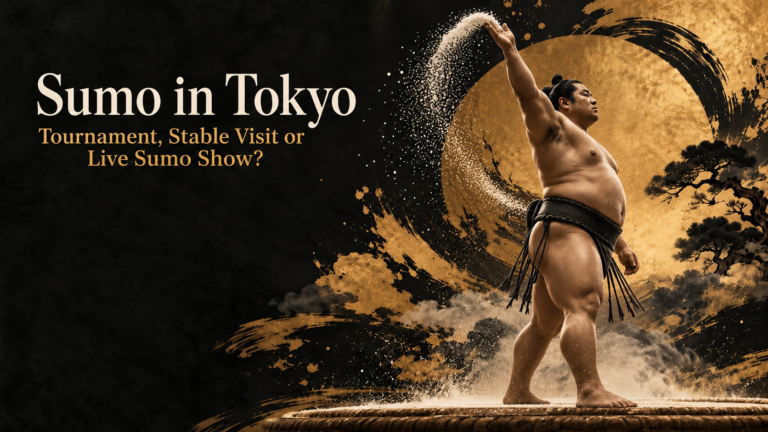
There are three main ways to experience sumo in Tokyo: watch an official Grand Sumo tournament, watch morning practice at a sumo stable, or attend a live sumo show designed for visitors. If your trip falls during a Tokyo tournament — held in January, May and September — go and see the real competition. If it doesn't, or you'd like someone to explain what you're seeing (and perhaps try a few moves yourself), a live sumo show is the practical choice. Stable practice is real training, but whether you can watch depends entirely on the stable.
The short answer: which sumo experience fits you?
Official Grand Sumo tournament | Morning practice at a stable | A live sumo show for visitors | |
|---|---|---|---|
What it is | Official professional competition run by the Japan Sumo Association | Wrestlers' daily training at the stable where they live and train | A visitor-oriented show combining sumo bouts, explanations and opportunities to take part; inclusions vary by venue |
When in Tokyo | January, May and September only, for 15 days each | Mornings, on days the stable is training and accepts visitors | Set by each venue; not tied to the tournament calendar |
Best for | Seeing ranked wrestlers compete for real results | Early risers who want to see training as it really happens | Visitors who want context, a relaxed setting and a chance to take part |
Check first | Tournament dates, venue and official seat sales | The stable's own calendar and visitor rules | What's included, language support, participation rules and cancellation terms |
You don't have to pick just one. If your dates allow, a tournament day and a sumo experience complement each other well: one lets you see the competition, the other explains what's behind it.
For January 2027 dates and official sales, see Tokyo Grand Sumo Tournament January 2027: Dates and Seats. For how morning practice visits work, see Sumo Morning Practice in Tokyo: How Stable Visits Work.
Option 1: An official Grand Sumo tournament
This is sumo at its most authentic — the professional competition itself. The Japan Sumo Association holds six Grand Sumo tournaments a year. Three take place in Tokyo, at the Kokugikan in Ryogoku (January, May and September), and one each in Osaka (March), Nagoya (July) and Fukuoka (November). Each tournament lasts 15 days.
A tournament day starts in the morning with bouts between the lowest-ranked wrestlers and builds towards the top-division bouts near the end of the day. Wrestlers in the top two divisions compete once a day, each day against a different opponent.
The next Tokyo tournament is the January 2027 Tournament at the Kokugikan, from 10 to 24 January 2027. According to the Association's schedule, advance sales for it start on 5 December 2026. Seating at the Kokugikan includes traditional masu-seki boxes, where you sit on the floor, and chair seats; the Association's English "How to Buy" page explains the seat types and links to its official sales site.
Popular tournaments can sell out on every day, so note the advance sales date and plan ahead.
Good to know: if your trip doesn't overlap with January, May or September, there is no Grand Sumo tournament in Tokyo during your stay. In December, for example, there is no tournament anywhere in Japan.
Option 2: Morning practice at a sumo stable (heya)
Professional wrestlers belong to stables (heya), where they live and train together. Watching morning practice — asa-geiko — lets you see the hard, repetitive work behind the bouts. It's real training, not a staged event, so it is authentic in a different way from a tournament.
The catch is access. Each stable decides whether, when and how visitors can watch, and a stable's listing in the Japan Sumo Association's directory is not an invitation to drop in. A stable is a working training space, not a visitor attraction.
One example of how this works: Arashio-beya in Nihonbashi-Hamacho, Chuo City, publishes a practice calendar on its official website. It explains that people may watch daily practice free of charge from the street through its large window, usually from about 7:30 a.m., without a reservation (the start and finish times differ slightly between the stable's pages, so check its calendar for the day) — but that this free viewing does not include entry inside the stable, that practice can be cancelled at short notice and that the schedule is not guaranteed. It asks visitors to keep quiet, not to use flash, not to eat or drink, and not to sit on the neighbours' steps. When the stable travels for a tournament outside Tokyo, there is no practice in Tokyo, so check its calendar before you go.
That last point applies more broadly: training follows the tournament calendar, so check a stable's own schedule before you set an alarm.
If you book an arranged stable visit through an organiser, confirm which stable you'll actually visit, how access is confirmed, the meeting point, language support, and the rules on photos, younger guests and leaving before practice ends.
Option 3: A live sumo show for visitors
Tokyo also has live sumo shows designed to help visitors understand the sport. Formats vary, so check each show's bouts, explanations, opportunities to take part and ticket inclusions. At Shinjuku Sumo Festival in Kabukicho, each ticket includes admission and one drink; no meal is included.
Is a live sumo show "authentic"?
Here is the honest answer. These experiences are not official competition and are not part of the Japan Sumo Association's tournaments. What they can offer is something a tournament or stable visit usually doesn't: explanation, a relaxed setting and, at some venues, the chance to take part.
So the useful question is not "Is it real?" but "What exactly does this venue offer?" Judge each one on what it confirms in writing, not on the photos or the name:
- Who leads it. Don't assume the people on stage are active professional wrestlers; read how the venue itself describes them.
- What's included. What the price covers, explanation, hands-on participation, photos — which are included and which cost extra?
- Participation. Can every guest take part, or only a selected few? Are there safety or other conditions?
- Language. Is the explanation offered in a language you understand, for every session?
Is it worth it?
Prices aren't comparable at a glance because each venue includes different things. Compare what you get — length, what is included, explanation, participation — and how flexible the booking is, rather than the headline figure alone.
Where Shinjuku Sumo Festival in Kabukicho fits
Shinjuku Sumo Festival in Kabukicho is a live sumo show at 5F, Tokyu Kabukicho Tower, in Shinjuku. Former professional sumo wrestlers fight real bouts up close and explain sumo in English, and guests aged 4 and over may volunteer for a sumo challenge. If there are too many volunteers, places are decided by lottery; participation is not guaranteed. All guests who wish to join the designated photo session may do so. We open on 1 December 2026, and tickets are on sale now on Japanticket. For prices and further details, see Shinjuku Sumo Festival in Kabukicho: What It Is and Where.
Questions to ask before you book any sumo experience
Whichever option you choose, these questions can save you disappointment:
- Does it fit my dates? Tournaments run on fixed dates; stables train on their own schedules.
- What exactly is included? What the price covers, explanation, photos, merchandise.
- Will I take part, or watch? If you want to try sumo yourself, check whether participation is guaranteed or by selection.
- What language is the explanation in?
- If you're travelling with younger guests, can they attend and take part? Conditions differ from venue to venue; check each option's own terms.
- What are the rules on photos and video?
- Can the venue handle my dietary needs? Ask before you book if this matters.
- What happens if my plans change? Read the change and cancellation terms.
- Am I booking on the official channel? Check the operator's own website and address.
Which one should you choose?
- Your trip overlaps with a Tokyo tournament (January, May or September): go to the tournament. It's the real competition, and you can add a sumo experience on another day for context.
- You're in Tokyo in another month: check whether a stable you're interested in publishes practice for your dates, or choose a live sumo show.
- You want explanation and a hands-on element: a live sumo show suits you best. Confirm participation rules before you book.
- You're travelling with younger guests: check each option's own conditions before you book.
- You'd like to understand the bouts first: read our guide to how a sumo bout is won before you go.
FAQ
Is a live sumo show "real" sumo?
It's separate from the Japan Sumo Association's official tournaments. Our show features real bouts by former professional sumo wrestlers, English explanations and a chance for guests to challenge a wrestler.
Can I see a Grand Sumo tournament in Tokyo in December?
No. Tokyo hosts tournaments in January, May and September, and there is no tournament in December. The next Tokyo tournament runs from 10 to 24 January 2027 at the Kokugikan.
Do I need to book to watch morning practice?
It depends on the stable. Some publish their own viewing rules; others accept visitors only through arranged visits. Always check the stable's own information first.
Is Shinjuku Sumo Festival in Kabukicho part of the official Grand Sumo tournaments?
No. It is a live sumo show in Kabukicho, Shinjuku, and is not affiliated with the Japan Sumo Association.
Plan your sumo experience in Tokyo
If your dates match a Tokyo tournament, see the real competition. If they don't, or you'd like sumo explained in a visitor setting, see Shinjuku Sumo Festival in Kabukicho: What It Is and Where. Confirm current dates and conditions on the official booking page.
Plan your visit
For current prices, participation conditions, arrival instructions and cancellations, read our booking information.