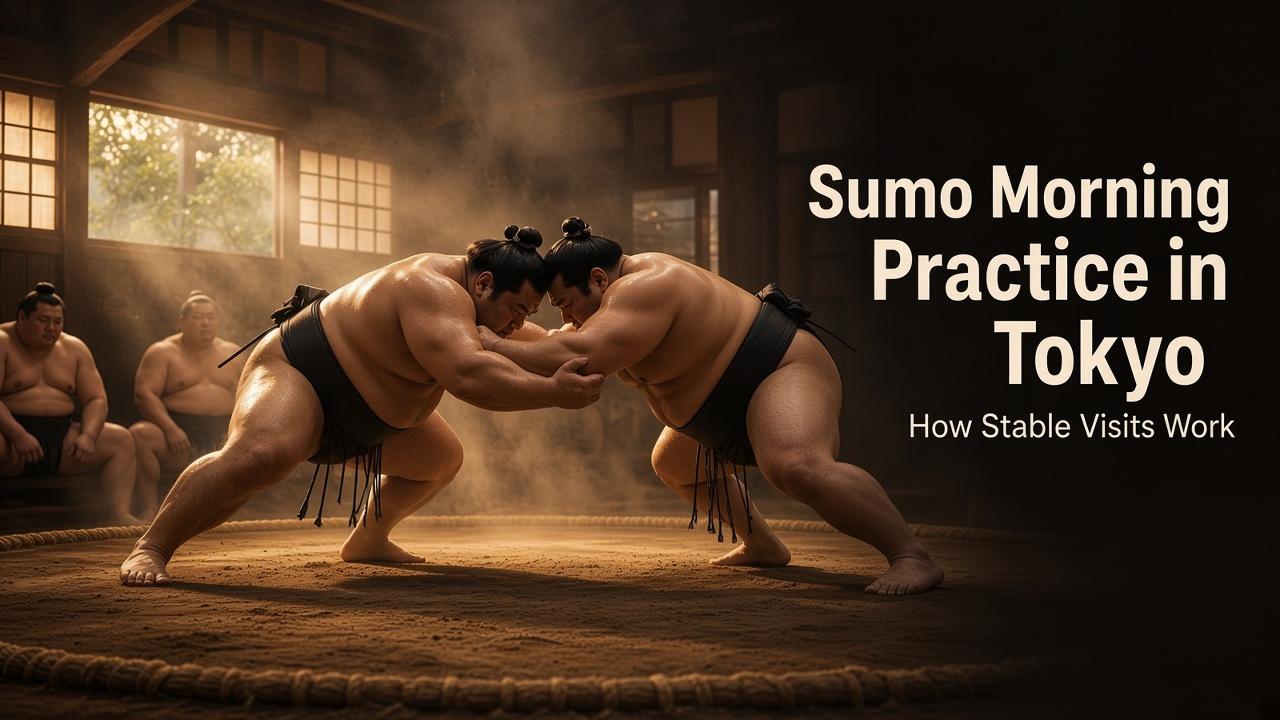
To watch sumo morning practice in Tokyo, you go to a sumo stable (heya) that lets visitors watch, on a day it is training, and follow that stable's own rules. Each stable decides whether and how visitors can watch. One Tokyo stable, Arashio, publishes a practice calendar and lets anyone watch free of charge through its street-level window, with no reservation, from about 7:30 a.m. Practice is not an event, so it can be cancelled at short notice, and it stops entirely while the stable is away at a tournament outside Tokyo.
Rules differ by stable; we use Arashio as the example because it publishes its rules. This guide explains how visits work and what to check before you set your alarm.
What a sumo stable is
A sumo stable is where professional wrestlers live and train under a stable master. The Japan Sumo Association publishes a guide to all its stables, and every wrestler belongs to one.
Morning practice is the stable's daily training, not something staged for visitors. It starts early in the morning, and wrestlers move from warming up on their own to practice bouts in the ring.
Many of the movements you'll see, such as shiko leg stamps and the crouch at the starting lines, are the same basic movements the Association teaches. See Sumo Rituals Explained: Salt, Shiko and Ring-Entering Rites.
Way 1: watching through the window, free
Arashio stable is in Nihonbashi-Hamacho, Chuo City. Its visitor page says:
- It's free, and no reservation is needed. Just turn up on a practice day.
- You watch from outside. You can't go inside; you watch through the large window from the street.
- Viewing starts at about 7:30 a.m. The end time varies. The stable's pages give different end times, so arrive early.
- There's no guarantee. Practice can be called off suddenly, so check the stable's calendar on the morning you plan to go. The calendar is the most up-to-date schedule.
- Don't call or email to ask. The stable says it can't give extra information by phone or email, and won't return answerphone messages.
- Anyone can watch, regardless of gender, according to the Japanese page.
Getting there: 2-47-2 Nihonbashi-Hamacho, Chuo-ku, Tokyo. It's a 3-minute walk from Hamacho Station on the Toei Shinjuku Line, or 10 minutes from Ningyocho Station on Tokyo Metro.
Way 2: a guided tour run by another organisation
Some stables also offer paid guided visits through official partners, with their own rules and booking conditions. Check the stable's official page for whatever it currently lists; we don't handle those visits, and we don't link out to other organisations' booking pages.
The rules for visitors
Arashio's visitor rules are short, and they matter: the stable is in a residential street, and practice is serious training.
- Keep quiet. Wrestlers are training, and noise carries.
- No flash. If you take photos or video, don't use flash or any other light.
- No eating or drinking outside the stable.
- Don't sit on the neighbours' steps. The houses around the stable are people's homes.
For general manners at a tournament, see Sumo Etiquette for Visitors: Do's and Don'ts.
When there's no practice in Tokyo
Practice follows the tournament calendar. There are six Grand Sumo tournaments a year: in Tokyo in January, May and September, in Osaka in March, in Nagoya in July and in Fukuoka in November.
When a tournament is held outside Tokyo, the stable travels with it. For example, while the November tournament is held in Fukuoka, Arashio holds no practice in Tokyo.
So check two things before you go:
- Is a tournament on? Check the Japan Sumo Association's tournament schedule.
- Is the stable training today? Check the stable's own calendar that morning.
Is a stable visit right for you?
A stable visit is ideal if you want to see real training up close and don't mind an early start. It isn't a tournament, and there's no ceremony or ranking at stake. If you're deciding between watching a tournament, visiting a stable and other ways to experience sumo, read Sumo in Tokyo: Tournament, Stable Visit or Live Sumo Show?.
FAQ
Is watching sumo morning practice free?
At Arashio stable, watching through the window is free and needs no reservation.
What time does sumo morning practice start?
At Arashio stable, viewing starts at about 7:30 a.m. The end time varies, so arrive early and check the stable's calendar that morning.
Can I go inside a sumo stable?
Not for Arashio's free viewing: you watch through the window from the street. Any paid visit inside a stable, if one is offered, has its own conditions on the organiser's official page.
Can I watch sumo practice in Tokyo in November?
Usually not at Arashio: the stable travels to Fukuoka for the November tournament. Check its calendar for the dates.
Is Shinjuku Sumo Festival in Kabukicho a sumo stable?
No. It's a live sumo show in Kabukicho, Shinjuku, not a sumo stable.
Learn sumo culture in Shinjuku
Shinjuku Sumo Festival in Kabukicho is a live sumo show at 5F, Tokyu Kabukicho Tower, in Shinjuku. Former professional sumo wrestlers fight real bouts up close and explain sumo in English, and guests aged 4 and over may volunteer for a sumo challenge. If there are too many volunteers, places are decided by lottery; participation is not guaranteed. All guests who wish to join the designated photo session may do so. We open on 1 December 2026, and tickets are on sale now on Japanticket. For prices and further details, see Shinjuku Sumo Festival in Kabukicho: What It Is and Where.
Plan your visit
For current prices, participation conditions, arrival instructions and cancellations, read our booking information.