Why do sumo wrestlers throw salt, rinse their mouths and stamp their feet before a bout? Most sumo rituals come from sumo's religious roots: they purify the ring, drive away evil and express respect, and they also give wrestlers time to focus. The Japan Sumo Association describes sumo's earliest matches as rituals dedicated to the gods with prayers for a good harvest, and much of that ceremony survives in the professional sport today.
This guide walks through the rituals in the order you'll see them: the water, the salt, the crouch and the stamps before a bout, then the ring-entering ceremonies and the bow twirl that closes the day.
Why do sumo wrestlers throw salt?
Salt is the ritual most visitors notice first. Each wrestler takes a handful from a bamboo basket at the east or west side of the ring and scatters it across the clay. According to the Association, the salt purifies the sacred area of the ring and expels evil, and it is also believed to protect the wrestler from injury. On a practical level, the Association adds, salt moistens the wrestler's hands and helps disinfect small scrapes.
Not every wrestler throws salt. It is a privilege of the top two divisions, makuuchi and juryo, and occasionally of the third division, makushita. In the lower ranks, bouts start almost straight away.
Chikaramizu: the water of strength
Before the salt comes water. A wrestler rinses his mouth with chikaramizu — literally "power water" — and wipes his body with paper. Water stands for purity, so the ritual cleanses body and mind before the bout.
There is a nice detail in who passes the water. In the top two divisions, the ladle is handed over by the winner of the previous bout or by the wrestler from the same side who is due to fight next, so the water always comes from a winner or a wrestler still to fight.
Sonkyo and chirichozu: respect and empty hands
Two quieter movements happen when the wrestlers face each other in the ring.
- Sonkyo. The wrestler rises onto his toes and crouches with his hips low and his back straight, knees opened wide. The Association's guide to basic sumo movements calls it a posture that expresses respect for the opponent.
- Chirichozu. Still crouching, the wrestler claps his hands, spreads his arms wide to both sides and turns his palms downward. It's a gesture of purification and fair play: open hands, nothing hidden.
If you watch closely, you'll see these at the start of every top-division bout, and they take only a few seconds.
Shiko: why sumo wrestlers stamp their feet
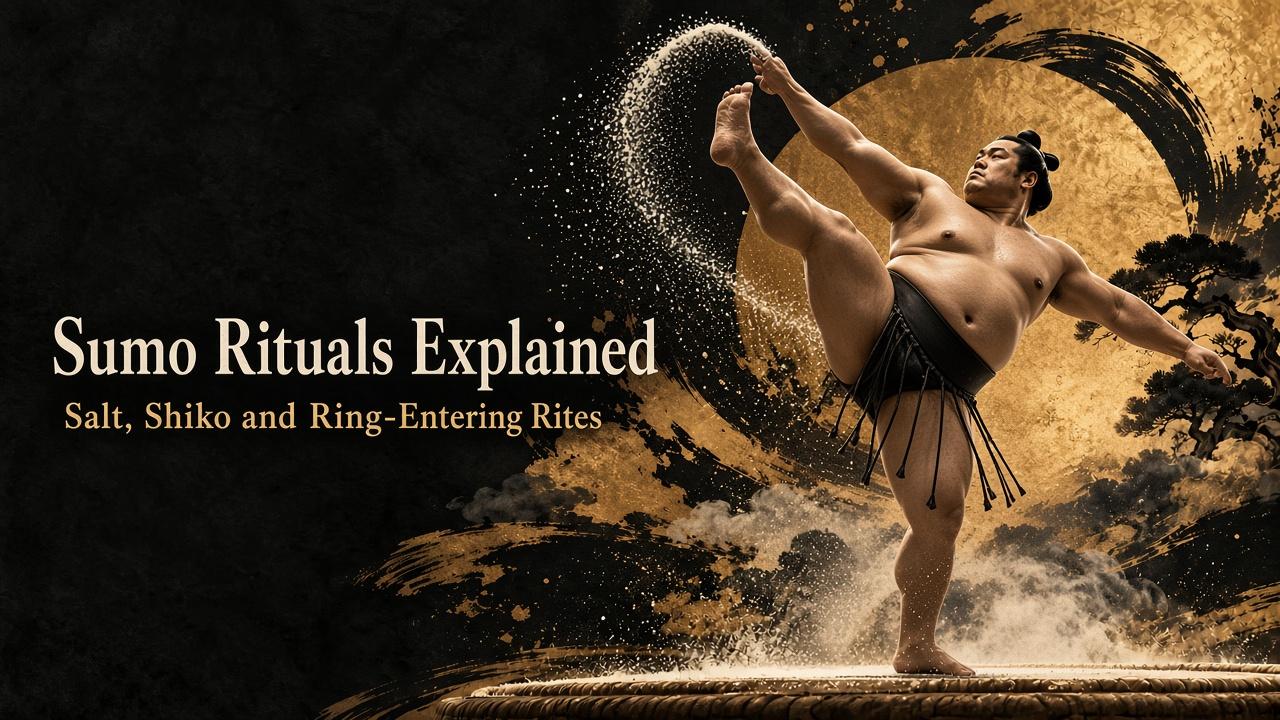
Shiko is sumo's famous leg-raising stamp. The wrestler shifts his weight to one side, lifts the other leg high and brings it down hard. In the ring it has a ritual meaning: in the yokozuna's ring-entering ceremony, the Association explains, each stamp symbolically drives evil out of the ring.
Shiko is also basic training. It is one of the ten forms in the Association's official guide to basic sumo movements. The guide stresses that the leg is raised by straightening the knee rather than pulled up by hand, that the chest stays up without leaning forward, and that the foot comes down toes first with a firm step. Because it is one of sumo's basic forms, you'll see it in training as well as in ceremonies.
Shikiri and tachiai: the build-up to the charge
After the salt, the two wrestlers crouch at the starting lines, fists on the clay, and stare each other down. Then they stand, return to their corners for more salt and do it again. This repeated crouch is called shikiri. For how long it can last, see our guide to the rules linked below.
The Association describes it as a kind of "cold war" that builds the tension for wrestlers and spectators alike. It ends with the tachiai, when both wrestlers synchronise their breathing, rise and charge. What happens next — and how a bout is won — is covered in our guide Sumo Rules for First-Time Visitors: How a Bout Is Won.
Dohyo-iri: the ring-entering ceremony
Each tournament day, just before the top-division bouts, the makuuchi wrestlers take part in the dohyo-iri, or ring-entering ceremony.
- Who wears what. The wrestlers wear keshomawashi: embroidered ceremonial aprons. What they're made of and what they cost are covered in Mawashi and Topknots: What Sumo Wrestlers Wear and Why.
- How it runs. Wrestlers from one side walk down an aisle in reverse order of rank, climb into the ring and go through a short, ancient ritual. Then they leave and the other side enters from the opposite aisle to repeat it.
- Earlier in the day, wrestlers in the second division, juryo, hold a similar ceremony before their own bouts.
It's one of the most colourful moments of a tournament day, and a good reason to be in your seat before the top-division bouts begin.
The yokozuna ring-entering ceremony
The leading role in the dohyo-iri belongs to the yokozuna, sumo's highest rank. Each yokozuna enters separately.
- His attendants. A senior referee leads him in, followed by two top-division wrestlers in ceremonial aprons: one goes ahead to clear the way, and the other carries a sword.
- The rope. Over his apron the yokozuna wears a thick braided rope tied in a bow at the back. Its material is covered in Mawashi and Topknots: What Sumo Wrestlers Wear and Why. Zigzag strips of white paper hang from the front — the same kind of paper found at Shinto shrines and on household shrine shelves in Japan.
- The movements. He claps to attract the attention of the gods, then extends his arms and turns his palms upward to prove he carries no weapons. At the climax, he lifts one leg high to the side, then the other, bringing each down with a resounding stamp to drive evil from the ring.
When one yokozuna has finished and withdrawn, the next one enters and repeats the ceremony.
Yumitorishiki: the bow twirl that ends the day
After the final bout of the day comes the yumitorishiki, the bow-twirling ceremony. A specially chosen wrestler, usually from makushita or below, climbs into the ring, receives a bow from the referee and twirls it in a series of sweeping movements.
The ceremony dates from the Edo period, when a winning wrestler was given a bow as a prize and twirled it to express his satisfaction. Today, the Association says, it can be seen as an expression of joy on behalf of all the day's winners. If you leave straight after the last bout, you'll miss it.
Rituals before the tournament begins
Some rituals happen before any bout is fought. Before a tournament begins, sumo referees hold the dohyo-matsuri, a Shinto ceremony to purify the ring and pray for a safe tournament. We explain it, and how the ring itself is built, in The Dohyo: What the Sumo Ring Means.
Quick guide: what each ritual means
Ritual | When you'll see it | What it means |
|---|---|---|
Chikaramizu (water) | Before the bout, top two divisions | Purifying body and mind |
Shiomaki (salt) | Before the bout, top two divisions | Purifying the ring, driving out evil, praying for safety |
Sonkyo (crouch) | Facing the opponent | Respect for the opponent |
Chirichozu (hands) | Facing the opponent | Purification; open, empty hands |
Shiko (stamp) | Ring-entering ceremonies and warm-up | Driving evil from the ring; basic training |
Shikiri (repeated crouch) | Before the charge | Building focus and tension |
Dohyo-iri | Before juryo and makuuchi bouts | Presenting the wrestlers in ceremonial aprons |
Yumitorishiki (bow twirl) | After the final bout | Joy on behalf of the day's winners |
New to the Japanese words? Our Sumo Glossary: Japanese Words to Know Before You Watch explains them in one place.
FAQ
Why do sumo wrestlers throw salt?
To purify the ring and drive out evil. According to the Japan Sumo Association, it is also believed to protect wrestlers from injury, and in practical terms it moistens the hands and helps disinfect scrapes.
Do all sumo wrestlers throw salt?
No. Salt throwing is a privilege of the top two divisions, makuuchi and juryo, and only sometimes of the third division, makushita.
What does the shiko stamp mean?
Shiko is a high leg-raise followed by a firm stamp. In ceremonies it symbolically drives evil from the ring, and it is also one of the basic training movements in sumo.
What is the dohyo-iri?
It's the ring-entering ceremony held before the second-division and top-division bouts each tournament day, with wrestlers in embroidered ceremonial aprons. Each yokozuna then has his own ring-entering ceremony.
What is the bow ceremony at the end of a sumo day?
It's the yumitorishiki. After the final bout, a chosen lower-ranked wrestler twirls a bow, a tradition that dates back to the Edo period.
See the rituals for yourself
Knowing what the salt and the stamps mean turns the minutes before a bout into part of the experience. To compare the ways to experience sumo in Tokyo — a tournament, a stable's morning practice or a live sumo show — read Sumo in Tokyo: Tournament, Stable Visit or Live Sumo Show?.
Shinjuku Sumo Festival in Kabukicho is a live sumo show at 5F, Tokyu Kabukicho Tower, in Shinjuku. Former professional sumo wrestlers fight real bouts up close and explain sumo in English, and guests aged 4 and over may volunteer for a sumo challenge. If there are too many volunteers, places are decided by lottery; participation is not guaranteed. All guests who wish to join the designated photo session may do so. We open on 1 December 2026, and tickets are on sale now on Japanticket. For prices and further details, see Shinjuku Sumo Festival in Kabukicho: What It Is and Where.
Plan your visit
For current prices, participation conditions, arrival instructions and cancellations, read our booking information.