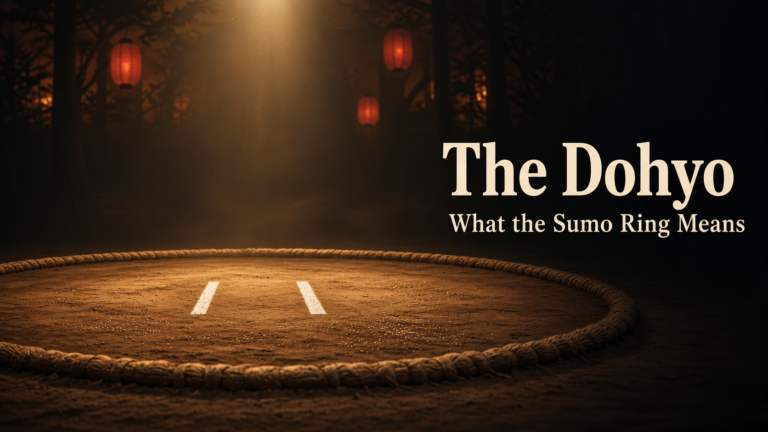
What is a dohyo? The dohyo is the sumo ring: a raised square platform of specially prepared clay, about 6.7 metres on each side and 60 centimetres high, with a circle of straw bales in the middle where the bout takes place. It is a sports surface and a sacred space at the same time — purified with salt during bouts and blessed in a Shinto ceremony before every tournament.
This guide explains how the ring is built, what its parts mean, how it has changed over the past century and why wrestlers treat it with such care.
The dohyo in numbers
Feature | Detail |
|---|---|
Platform | About 6.7 m square; 60 cm high |
Material | A special kind of clay, with a thin layer of sand on top |
Fighting circle | 4.55 m in diameter |
Boundary | Straw rice bales, mostly buried in the clay |
Above the ring | A suspended roof in the style of a Shinto shrine, with a large tassel at each corner |
The name itself comes from the straw bales. According to the Japan Sumo Association, the ring is named after the straw rice bags that mark out its parts.
Clay, sand and straw: how the ring is built
The platform is made of clay, firm enough to stand and push on, with a fine layer of sand over the hard surface. The straw bales that form the circle aren't simply laid on top: the greater part of each bale is buried firmly in the clay, so only a low ridge stands above the surface.
That ridge matters. A wrestler loses as soon as his foot touches the ground beyond the bales, so the edge of the circle is where many bouts are decided. If you're new to the rules, our guide Sumo Rules for First-Time Visitors: How a Bout Is Won explains the two ways to win.
A fresh surface for every tournament
The ring isn't permanent. The Association explains that it is partly rebuilt for every tournament: about 20 centimetres of soil is taken off the top, new soil is added and the surface is levelled again. So each tournament begins on a newly prepared ring.
The roof and the four tassels
Look up at a tournament and you'll see a roof hanging above the ring, suspended from the ceiling by cables. Its design resembles the roof of a Shinto shrine, a reminder of sumo's religious origins.
At each corner of the roof hangs a large tassel. The Association says the four tassels stand for the four seasons of the year.
The roof wasn't always suspended. Until 1952, four pillars stood at the corners of the ring to support it. That September, the Association removed the pillars and replaced them with the hanging roof and four coloured tassels you see today.
How the ring has changed over the last century
The modern dohyo took shape in a few steps, recorded in the Association's history:
- 1928: a time limit for the pre-bout ritual and the starting lines in the centre of the ring were introduced.
- 1931: the fighting circle was enlarged from 13 shaku to 15 shaku (4.55 metres), and the old double ring was changed to the single ring used today.
- 1952: the four corner pillars were removed and the suspended roof with four tassels was introduced.
The ring you see now is a mix of very old symbolism and rules refined in the 20th century.
Dohyo-matsuri: the ceremony that blesses the ring
Before a tournament begins, the ring is blessed in the dohyo-matsuri, or ring festival. The ceremony is led by one of the top-ranked referees, who acts as the Shinto officiant. He recites prayers and makes offerings for safety during the tournament and its success, and for peace in the nation and good harvests.
As part of the ritual, a hole is opened in the centre of the ring and lucky offerings are placed inside: salt, kelp, dried squid, dried chestnuts, washed rice and kaya nuts. The Association's chairman, the judges, all the referees and other members attend.
Wrestlers don't attend. For some tournaments, the Association opens the ceremony to the public free of charge on a first-come basis and asks spectators to watch quietly. If you hope to attend, check the Association's announcements for your tournament.
Why the ring is treated as sacred
Several everyday rituals make sense once you know the dohyo is a sacred space:
- Salt. Wrestlers in the top two divisions scatter salt to purify the ring and drive out evil. The salt is kept in bamboo baskets at the east and west sides of the ring.
- Water and paper. Before a bout, wrestlers rinse their mouths with water and wipe themselves with paper to purify body and mind.
- The ceremonies. The ring-entering ceremonies and the yokozuna's stamps are said to drive evil from the ring.
We explain each of these in Sumo Rituals Explained: Salt, Shiko and Ring-Entering Rites.
Where you can see a dohyo in Tokyo
In Tokyo, the Grand Sumo tournaments of January, May and September are held at the Kokugikan in Ryogoku, a one-minute walk from JR Ryogoku Station according to the Association. When there's no sumo, the hall is also hired out for other events.
Sumo stables also have their own practice rings, and some stables let visitors watch practice under their own rules. Our comparison guide explains the options: Sumo in Tokyo: Tournament, Stable Visit or Live Sumo Show?.
New to the Japanese words? See our Sumo Glossary: Japanese Words to Know Before You Watch.
FAQ
What is a dohyo made of?
A dohyo is made of a special kind of clay with a thin layer of sand on top. The fighting circle is marked with straw rice bales, most of each bale buried in the clay.
How big is a sumo ring?
The platform is about 6.7 metres square and 60 centimetres high, and the fighting circle is 4.55 metres in diameter.
What do the four tassels above the sumo ring mean?
According to the Japan Sumo Association, the four tassels hanging from the corners of the roof represent the four seasons.
Is the sumo ring rebuilt for each tournament?
Partly. The top layer of about 20 centimetres of soil is removed, new soil is added and the surface is levelled again before each tournament.
What is the dohyo-matsuri?
It's the Shinto ceremony held before a tournament to bless the ring, led by a top-ranked referee, with offerings placed in the centre of the ring.
Experience sumo in Tokyo
Shinjuku Sumo Festival in Kabukicho is a live sumo show at 5F, Tokyu Kabukicho Tower, in Shinjuku. Former professional sumo wrestlers fight real bouts up close and explain sumo in English, and guests aged 4 and over may volunteer for a sumo challenge. If there are too many volunteers, places are decided by lottery; participation is not guaranteed. All guests who wish to join the designated photo session may do so. We open on 1 December 2026, and tickets are on sale now on Japanticket. For prices and further details, see Shinjuku Sumo Festival in Kabukicho: What It Is and Where.
Plan your visit
For current prices, participation conditions, arrival instructions and cancellations, read our booking information.