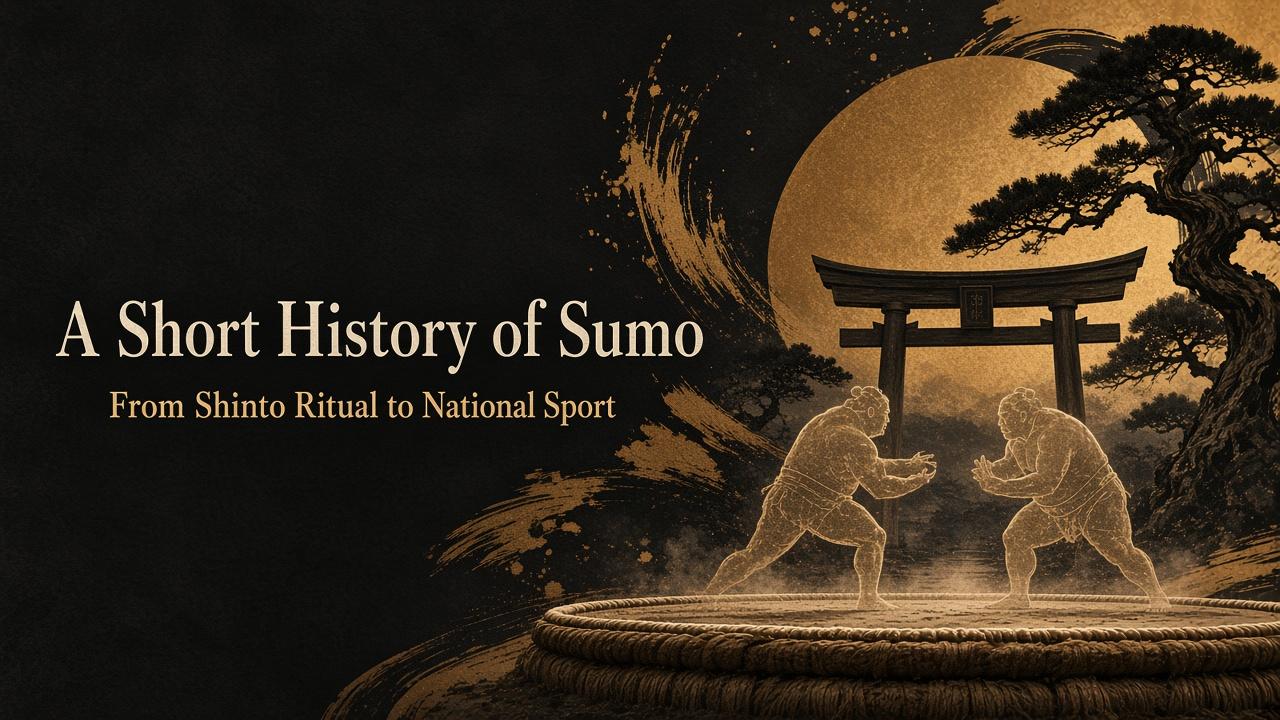
Where does sumo come from? Sumo began as a religious ritual: early bouts were dedicated to the gods with prayers for a good harvest, and over some 1,500 years the ritual became a court ceremony, a warrior's training and finally a professional sport. The Japan Sumo Association traces today's Grand Sumo back to professional groups formed in the Edo period (1603–1868), and much of what you see in the ring still reflects those roots.
Here is the story in six stages, with the dates the Association itself uses.
A timeline of sumo at a glance
Period | What happened |
|---|---|
Ancient legend | Japan's oldest chronicles, the Kojiki (712) and the Nihon Shoki (720), include myths of trials of strength and the legendary bout between Nomi-no-Sukune and Taima-no-Kehaya |
8th century (Nara period) | Sumo enters the ceremonies of the imperial court, as a yearly event that continues for about 300 years |
Kamakura to Warring States periods | Sumo is practised as combat training for warriors |
1570s–early 1580s | Oda Nobunaga holds sumo contests at Azuchi Castle and other places, taking winners into his service |
Edo period | Professional sumo groups form; regular events begin; sumo becomes a mass entertainment alongside kabuki |
1925–1927 | The forerunner of today's Japan Sumo Association is established, and the Tokyo and Osaka associations merge |
1954 / 1985 | The Kuramae Kokugikan opens, followed by today's Ryogoku Kokugikan |
Myths and harvest rituals
Sumo's origins sit somewhere between legend and religion. The Association points to the myths of contests of strength in Japan's two oldest chronicles, the Kojiki of 712 and the Nihon Shoki of 720, and to the legend of a bout between two strongmen, Nomi-no-Sukune and Taima-no-Kehaya, fought before the emperor. The Association's English guide adds another legend: that the god Takemikazuchi won a sumo bout against the leader of a rival tribe, and that this victory decided who would rule the islands of Japan.
Away from legend, the Association describes sumo's earliest matches as rituals dedicated to the gods, held with prayers for a good harvest. They took place within the grounds of shrines, together with sacred dance and drama. Sumo was also held each year as part of festivals to foretell how the year's crops would turn out.
Sumo at the imperial court
In the 8th century, during the Nara period, the imperial court made sumo part of its ceremonies. Every year the court held a sumo festival, where the winners joined in the music and dance, and this court tradition lasted for about 300 years.
Early sumo was rough. The Association's guide describes it as highly competitive, a mix of striking and grappling with almost no restrictions. Under the court's continued patronage, rules were drawn up and techniques developed, moving sumo closer to the form we know.
Samurai and warlords
From the Kamakura period, when a military government was established in 1192, through the Warring States period, Japan was ruled by warriors. Sumo was valued for its usefulness in combat and was practised widely as training for fighting men. According to the Association, jujitsu later developed among the samurai as an offshoot of sumo.
One famous patron was the warlord Oda Nobunaga, who loved sumo. In the 1570s and early 1580s (the Genki and Tensho eras), he gathered wrestlers from across the country for contests he watched in person, at Azuchi Castle in Omi and elsewhere, and took the winners into his service as retainers. The Association also notes that sumo referees, the gyoji, first appeared during this era.
Edo: sumo becomes a profession
Peace came when the warring factions were united under the Tokugawa shogunate in 1603. As towns and a merchant class grew, people began to make a living from sumo. Fund-raising sumo events known as kanjin-zumo spread across the country, and by the middle of the Edo period, sumo events were being held regularly.
Three great champions — Tanikaze, Onogawa and Raiden — drew huge crowds, and the shogun himself watched sumo. Its popularity grew quickly, and sumo became one of the great entertainments of ordinary people, alongside kabuki. The Association says the foundations of today's Grand Sumo were laid at this time, and that the present Association has its origins in the professional groups first formed in the Edo period.
Several things you'll still see today date from these centuries:
- The banzuke ranking list in its long, top-to-bottom format, used since the late 18th century.
- The ring-entering ceremony and the embroidered ceremonial aprons, which the Association describes as continuing since the Edo period.
- The topknot hairstyles, derived from fashions of the Edo period.
- The bow-twirling ceremony at the end of the day, which dates from the Edo period.
The modern era: an association, a ring and a hall
In the 20th century, Grand Sumo took on its modern shape. The Association's own history lists these milestones:
- December 1925: the Dai-Nippon Sumo Kyokai, the forerunner of today's Japan Sumo Association, is established as an incorporated foundation.
- January 1927: the Tokyo and Osaka sumo associations merge.
- 1928–1952: the ring and the pre-bout rules take their modern shape. The details are in The Dohyo: What the Sumo Ring Means.
- September 1954: the Kuramae Kokugikan opens. The Sumo Museum is founded at the same time.
- January 1985: the new Ryogoku Kokugikan opens. The Sumo Museum has been there ever since.
Sumo today
Today, the Japan Sumo Association holds six Grand Sumo tournaments a year: three in Tokyo, at the Kokugikan in Ryogoku (January, May and September), and one each in Osaka, Nagoya and Fukuoka. For how the ranks work, from yokozuna down, see Sumo Ranks Explained: From Yokozuna to Jonokuchi.
The Association sums up sumo as having many sides — history, culture, Shinto ritual and competition — and invites fans to experience in person the traditions that have continued for centuries. To understand the rituals you'll see, read Sumo Rituals Explained: Salt, Shiko and Ring-Entering Rites.
Where to see sumo history in Tokyo
The Sumo Museum on the ground floor of the Ryogoku Kokugikan displays items such as woodblock prints, past ranking lists and ceremonial aprons. Entry is free outside Grand Sumo tournaments. During a tournament at the Kokugikan, a tournament admission ticket is required. Opening days vary, so check the museum's calendar on the Association's website before you go.
FAQ
How old is sumo?
The Japan Sumo Association describes sumo as about 1,500 years old.
Did sumo start as a religious ritual?
Yes. According to the Japan Sumo Association, the first sumo matches were rituals dedicated to the gods, with prayers for a good harvest, held at shrines alongside sacred dance and drama.
When did sumo become professional?
Professional sumo groups formed in the Edo period, after 1603, and regular sumo events were being held by the middle of the period. Today's Japan Sumo Association has its origins in those groups.
When was the Japan Sumo Association founded?
Its forerunner, the Dai-Nippon Sumo Kyokai, was founded in December 1925, and the Tokyo and Osaka associations merged in January 1927.
Is sumo Japan's national sport?
Sumo is often described as Japan's national sport. The Association's English guide says it became the de facto national sport during the Edo period.
Experience sumo's traditions in Tokyo
If you'd like to see these traditions for yourself, our comparison guide explains your options: Sumo in Tokyo: Tournament, Stable Visit or Live Sumo Show?.
Shinjuku Sumo Festival in Kabukicho is a live sumo show at 5F, Tokyu Kabukicho Tower, in Shinjuku. Former professional sumo wrestlers fight real bouts up close and explain sumo in English, and guests aged 4 and over may volunteer for a sumo challenge. If there are too many volunteers, places are decided by lottery; participation is not guaranteed. All guests who wish to join the designated photo session may do so. We open on 1 December 2026, and tickets are on sale now on Japanticket. For prices and further details, see Shinjuku Sumo Festival in Kabukicho: What It Is and Where.
Plan your visit
For current prices, participation conditions, arrival instructions and cancellations, read our booking information.