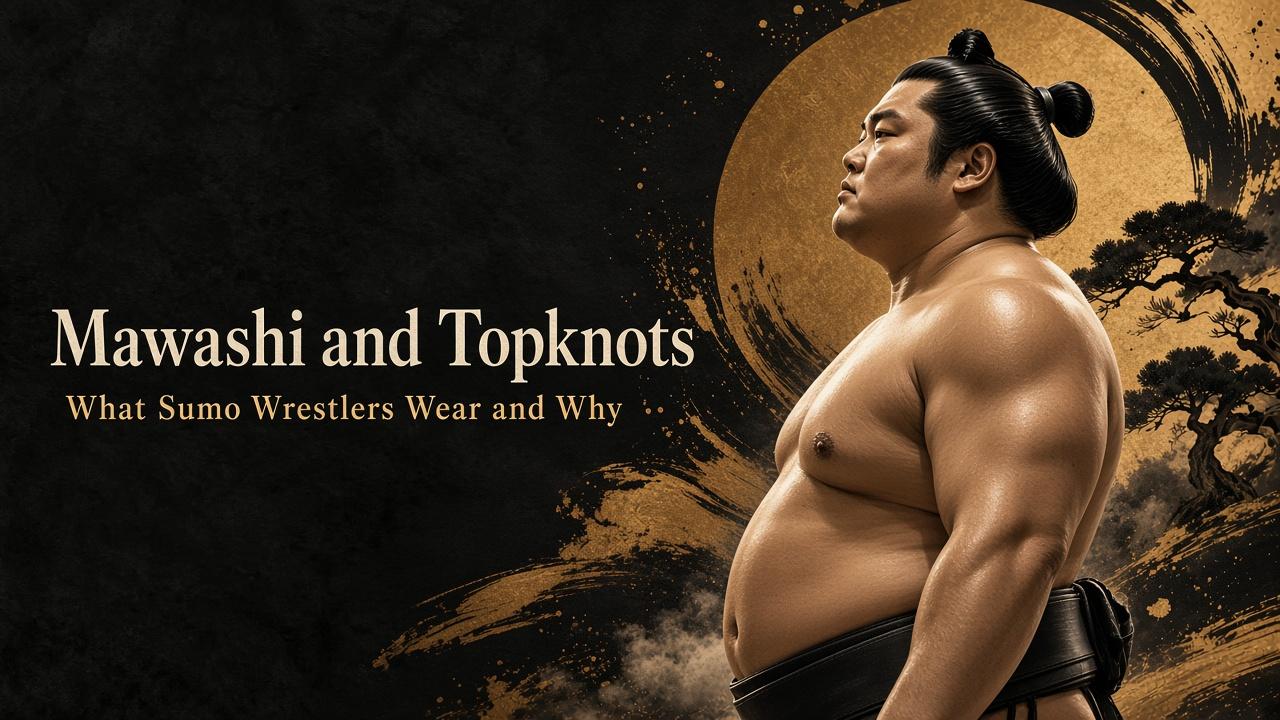
What do sumo wrestlers wear? In a bout, a sumo wrestler wears only a mawashi, a long belt wrapped tightly around the waist, and his hair is tied in a topknot whose style depends on his rank. For ceremonies, top-division wrestlers add an embroidered apron, and a yokozuna adds a heavy braided rope.
None of this is costume for its own sake. The belt shapes how sumo is fought, and the topknot has a practical job too. Here's what each item is and why it matters.
The mawashi: the belt that shapes sumo
The mawashi is the wrestler's one piece of fighting equipment. Top-ranked wrestlers (sekitori) fight in a heavy silk mawashi; according to the Japan Sumo Association, lower-ranked wrestlers wear a cotton one and switch to a colourful silk mawashi on promotion to juryo. The Association's English introduction describes the silk mawashi as about 9 metres long and 80 centimetres wide, folded into six layers and wound around the waist four to seven times, depending on the wrestler's size.
Why the mawashi matters in a bout
The Association goes as far as saying the mawashi may have determined the whole form of sumo. That's because grips matter: many of the official winning techniques are achieved by controlling the opponent through a hold on his belt. Watch a bout and you'll often see both wrestlers fighting for the best grip before anyone moves forward.
There is one firm limit. Grabbing the part of the belt that covers the groin is against the rules.
The strings at the front
Hanging from the front of the mawashi you'll see a row of stiff strings. These are made of silk stiffened with glue and are purely decorative. They sometimes come loose during a bout, in which case they can simply be discarded.
Can anyone tie one?
Tying a mawashi properly takes practice and, usually, a helper. The Japan Sumo Association publishes an illustrated, step-by-step guide (in Japanese) to tying one for amateur sumo, showing how the belt is folded and wound. It's a reminder that the mawashi is equipment as much as clothing.
Keshomawashi: the ceremonial apron
Before the top-division bouts each tournament day, wrestlers take part in the ring-entering ceremony wearing a keshomawashi. It's a ceremonial apron that hangs down the front, made of silk, richly embroidered with individual designs and hemmed with gold fringe.
These aprons are works of craft. The Association notes that a keshomawashi can cost more than one million yen. They aren't worn for fighting; they appear in ceremonies such as the dohyo-iri, which we explain in Sumo Rituals Explained: Salt, Shiko and Ring-Entering Rites.
The yokozuna's rope
A yokozuna, sumo's highest rank, wears something extra for his own ring-entering ceremony: a thick braided rope worn over his ceremonial apron and tied in a bow at the back. According to the Association, it is made of hemp wrapped in bleached cotton, with three strands twisted together, and a new one is made at the yokozuna's stable before each Tokyo tournament. Its size varies with the wrestler's build.
From the front of the rope hang strips of white paper folded in a zigzag pattern. In Japan, these zigzag paper strips are a widely recognised religious symbol: the same kind of paper hangs at Shinto shrines and over the household shrine shelf, where offerings are made at New Year and on other occasions. For more on the rank, see Sumo Ranks Explained: From Yokozuna to Jonokuchi.
Sumo hairstyles: the oichomage and the chonmage
Professional wrestlers grow their hair long so it can be tied up. There are two styles, and the difference tells you a wrestler's level at a glance.
Hairstyle | Who wears it | What it looks like |
|---|---|---|
Oichomage | Wrestlers in juryo and makuuchi, the top two divisions | An elaborate topknot shaped like a ginkgo leaf, which gives it its name |
Chonmage | Wrestlers in the lower divisions | A plainer topknot tied with paper string |
Why sumo wrestlers wear topknots
The Association gives two reasons. First, tradition: the styles come from hairstyles that were fashionable in the Edo period. Second, protection: the topknot also helps protect the head when a wrestler falls.
The topknot is also part of the rules. A wrestler loses if any part of his body other than the soles of his feet touches the ground — and that includes his topknot. Pulling an opponent's hair, on the other hand, is prohibited. The rules of a bout are explained in Sumo Rules for First-Time Visitors: How a Bout Is Won.
What the officials wear
The wrestlers aren't the only ones in traditional dress.
- Referees (gyoji) wear kimono modelled on the style of samurai from the Kamakura period, about 800 years ago, with black gauze court hats that resemble a Shinto priest's hat. Higher-ranked referees wear split-toe tabi socks and straw sandals, while lower-ranked referees go barefoot. The two top referees carry a short sword, and referees at the sanyaku level and above wear a small inro case at the waist.
- Judges (shimpan) sit around the ring in formal black kimono. All of them are former wrestlers.
A look unchanged since the Edo period
The Association notes that many elements of Grand Sumo — the ring-entering ceremony, the banzuke ranking list, the ceremonial aprons, the topknots and the kimono — look much as they did in the Edo period. Seeing them in person is part of what makes sumo feel like living history. For the bigger story, read A Short History of Sumo: From Shinto Ritual to National Sport.
FAQ
What is a sumo mawashi made of?
Top-ranked wrestlers (sekitori) fight in a heavy silk mawashi about 9 metres long and 80 centimetres wide, folded into six layers and wrapped around the waist four to seven times. Lower-ranked wrestlers wear cotton.
Why do sumo wrestlers wear topknots?
The styles come from Edo-period hairstyles, and the Japan Sumo Association says they have also been kept because they help protect the head in a fall.
What is the difference between an oichomage and a chonmage?
The oichomage is the elaborate ginkgo-leaf topknot worn by wrestlers in the top two divisions. The chonmage is a plainer style tied with paper string, worn by lower-ranked wrestlers.
What is a keshomawashi?
It's the embroidered silk ceremonial apron that top-division wrestlers wear for the ring-entering ceremony. It isn't worn for fighting.
What is a yokozuna's rope made of?
It is made from hemp wrapped in bleached cotton, with three strands twisted together. Its size varies with the wrestler's build.
Experience sumo in Tokyo
To compare the ways to see sumo in Tokyo, read Sumo in Tokyo: Tournament, Stable Visit or Live Sumo Show?.
Shinjuku Sumo Festival in Kabukicho is a live sumo show at 5F, Tokyu Kabukicho Tower, in Shinjuku. Former professional sumo wrestlers fight real bouts up close and explain sumo in English, and guests aged 4 and over may volunteer for a sumo challenge. If there are too many volunteers, places are decided by lottery; participation is not guaranteed. All guests who wish to join the designated photo session may do so. We open on 1 December 2026, and tickets are on sale now on Japanticket. For prices and further details, see Shinjuku Sumo Festival in Kabukicho: What It Is and Where.
Plan your visit
For current prices, participation conditions, arrival instructions and cancellations, read our booking information.